|
pacemaker 3.2.3
COM automation for people with deadlines and a hatred of GUIs
|

|
|
pacemaker 3.2.3
COM automation for people with deadlines and a hatred of GUIs
|
|
Tokenizer and record accumulator for CSV parsing. More...
#include <CSVLexer.hpp>
Public Member Functions | |
| CSVLexer (std::istream *in) | |
| Constructs a lexer bound to the given input stream. | |
| virtual | ~CSVLexer ()=default |
| Virtual destructor; no additional cleanup beyond the base class. | |
| auto | yylex (std::string *const yyval) -> int |
| Scans the next token from the input stream. | |
| auto | newline () -> void |
| Begins a new record by appending an empty row to the result. | |
| auto | append (const std::string &field) -> void |
| Appends a field value to the current (last) record. | |
| auto | data () const &-> const std::vector< std::vector< std::string > > & |
| Returns a copy of all records accumulated so far. | |
| auto | data () &&-> std::vector< std::vector< std::string > > |
| Moves all records accumulated so far. | |
| auto | reset () -> void |
| Clears all accumulated records. | |
Tokenizer and record accumulator for CSV parsing.
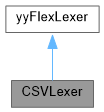
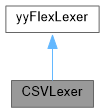
CSVLexer extends the Flex-generated yyFlexLexer base with:
yylex(std::string*) overload that returns the token kind and writes the matched text (for TEXTDATA tokens) into the caller-supplied string, matching the define api.value.type and YY_DECL signature configured in csv.l;newline(), append) that the Bison grammar actions in csv.y call as each field and record boundary is recognised;data(), reset()) for retrieving and clearing the accumulated result.The lexer recognises five token kinds, defined in csv.l: CR (\r), LF (\n), COMMA (,), DQUOTE ("), and TEXTDATA (one or more printable ASCII characters excluding comma and double-quote). Token classification is the lexer's only responsibility; quote-doubling unescape logic and record/field structure are handled by the grammar actions in csv.y, which call back into this class via append() and newline().
Instances are short-lived : CSV::parse_helper() constructs one CSVLexer per parse, binds it to CSVParser, and discards it after extracting the result via data().
CSVParser class (declared in the Bison-generated bison-csv.hpp, built from csv.y) is the sole caller of yylex(), append(), and newline(). Definition at line 39 of file CSVLexer.hpp.
|
inline |
Constructs a lexer bound to the given input stream.
Forwards in to the yyFlexLexer base constructor, which uses it as the source of characters for tokenization.
| in | Pointer to the input stream to read from. Must outlive the lexer; ownership is not transferred. |
Definition at line 50 of file CSVLexer.hpp.
|
virtualdefault |
Virtual destructor; no additional cleanup beyond the base class.
| auto yylex | ( | std::string *const | yyval | ) | -> int |
Scans the next token from the input stream.
Implemented in the Flex-generated source produced from csv.l. For a matched TEXTDATA token, the matched text is copied into *yyval; for all other token kinds (CR, LF, COMMA, DQUOTE) *yyval is left unmodified, since the token kind alone is sufficient information for the grammar.
This signature matches the YY_DECL macro defined in csv.l and is invoked by the generated CSVParser as its yylex callback (see code { #define yylex lexer.yylex } in csv.y).
| yyval | Output parameter receiving the matched text for TEXTDATA tokens. Must not be null. |
pacemaker::io::CSVParser::token enumerator value, or 0 at end of input.
|
inline |
Begins a new record by appending an empty row to the result.
Called by the grammar action for the records rule in csv.y each time a complete record has been recognised, including after the first record. As a side effect of append()'s lazy-initialisation check, the very first record does not required an explicit newline() call before its first field is appended.
Definition at line 82 of file CSVLexer.hpp.
|
inline |
Appends a field value to the current (last) record.
Called by the grammar action for the record rule in csv.y each time a field non-terminal is reduced.
| field | The unescaped field value, as computed by the grammar's escaped or nonescaped rule. |
Definition at line 91 of file CSVLexer.hpp.
|
inline |
Returns a copy of all records accumulated so far.
Definition at line 98 of file CSVLexer.hpp.
|
inline |
Moves all records accumulated so far.
Definition at line 105 of file CSVLexer.hpp.
|
inline |
Clears all accumulated records.
After calling reset(), data() returns an empty vector until new records are accumulated via append() / newline(). Allows a single CSVLexer instance to be reused for multiple parses, although the current CSV::parse_helper() implementation constructs a fresh lexer per call instead of reusing one.
Definition at line 114 of file CSVLexer.hpp.
 1.12.0